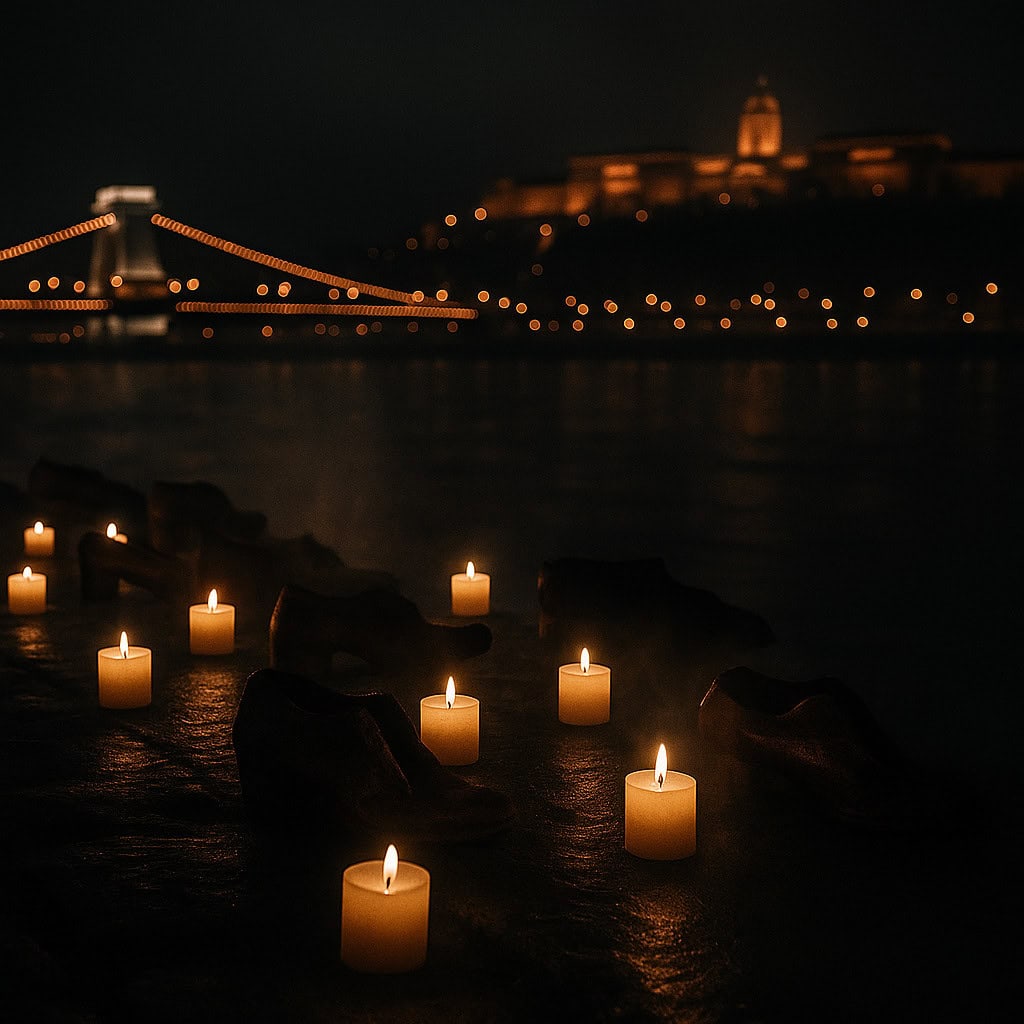
Along the serene riverbank where the Danube glimmers under the city’s lights, a line of old-fashioned shoes sits silently, facing the water.
They do not move, but they tell a story that once shook the world.
The Shoes on the Danube Bank Budapest memorial stands as one of the most moving tributes to human loss in Europe — a reminder of both cruelty and courage, of tragedy and remembrance.
The Story Behind the Shoes
During World War II, Budapest witnessed one of its darkest moments. In 1944–45, the fascist Arrow Cross Party, allied with Nazi Germany, terrorized the city’s Jewish population. Thousands of men, women, and children were rounded up, taken to the riverbank, and shot so that their bodies fell into the freezing Danube.
Before execution, they were ordered to remove their shoes — valuable leather items that could be reused or sold.
Today, sixty pairs of iron shoes, sculpted by Gyula Pauer and conceived by director Can Togay, line the river near the Hungarian Parliament Building. They represent those who perished — mothers, fathers, and children — forever waiting at the edge of the river.
A Minimalist Monument with Infinite Weight
The Shoes on the Danube Bank Budapest memorial was inaugurated in 2005, yet it feels timeless. It does not rise above the skyline or call attention with grandeur. Instead, it whispers — and in that whisper lies its strength.
Rust gathers on the metal; flowers and candles rest inside the shoes; the Danube flows silently beside them. The simplicity of the scene captures the unspeakable magnitude of what happened there. It is one of those rare places where history breathes in the present.
The Setting — Between Water and Silence
Located on the Pest side of the Danube Promenade, between the Parliament and the Chain Bridge, this stretch of riverbank is one of the most beautiful — and now, one of the most sacred — in Budapest.
At sunset, when the light reflects off the Parliament’s golden façade, the memorial glows softly, and the contrast between beauty and horror becomes almost unbearable. It is this tension that makes the site unforgettable.
Many visitors choose to walk there after exploring Liberty Square, another area marked by World War II memory. The short distance between these two monuments captures both the city’s splendor and its sorrow.
A Place of Reflection and Responsibility
Standing before the Shoes on the Danube Bank Budapest, one cannot help but feel the fragility of peace. The shoes are empty, yet they are full — full of stories, full of absence.
Locals often light candles on national remembrance days, and school groups visit to learn what happened here. The memorial transcends religion and nationality; it is not only a Jewish memorial but a universal one — a reminder of what happens when hatred becomes law.
If you want to understand Budapest beyond its beauty, this is where to start.
It is not a tourist attraction. It is a mirror.
From Darkness to Light
The memorial’s power lies in its restraint. It does not show suffering, only what remains.
The sculptor once said that he designed it so that “the shoes could be filled with imagination” — and indeed they are. Each visitor imagines the person who wore them, their last thoughts, the sounds of the city above, and the current below.
At night, the reflections of street lamps shimmer on the water, making the shoes appear almost alive.
In that light, you can sense what Budapest Night Walking Route once was — a city of ghosts and survivors walking side by side.
How to Visit Shoes on the Danube Bank Budapest
Location
You’ll find the memorial on the riverbank between Parliament and Chain Bridge, on the Pest side.
The nearest tram stop is Kossuth Lajos tér, served by line 2 — one of the most scenic tram rides in Europe.
When to Go
- Early morning: Peaceful, ideal for quiet reflection.
- Sunset: The warm light softens the view and enhances the emotional impact.
- After dark: The candles lit by locals create an almost sacred glow.
It’s worth combining your visit with a walk along the Danube Promenade or even a Danube River Cruise Budapest to see the Parliament and the memorial illuminated at night.
The Danube — Witness of History
Few rivers in Europe have witnessed as many contrasts as the Danube. It has been both a line of beauty and a line of death. The Shoes on the Danube Bank Budapest turns this duality into art: the same water that once carried away the victims now reflects the peace of a rebuilt city.
Across the river, the lights of Buda Castle and Fisherman’s Bastion glow like guardians of memory — silent witnesses to a story that must never be forgotten.
Why You Should Visit
Budapest is a city of contrasts — of joy and grief, grandeur and scars.
The Shoes on the Danube Bank Budapest reminds every traveler that beauty and tragedy often coexist. Visiting this place means confronting history not as a distant event, but as something human, personal, and real.
It is a quiet experience — one that leaves you speechless, yet more connected to what it means to be alive.
Conclusion
The Shoes on the Danube Bank Budapest memorial is not about the past. It’s about what we choose to remember today. The river still flows, the city still shines, but those silent shoes will always remain — a symbol of the cost of forgetting.
Here, in the heart of Budapest, the Danube carries both sorrow and hope.
And in that balance, you’ll find the soul of the city itself.
Shoes on the Danube Bank Budapest — Location on the Map
Located between the Parliament and the Chain Bridge, the Shoes on the Danube Bank memorial stands as a solemn tribute to Budapest’s Jewish victims of World War II. The simplicity of the iron shoes against the river’s edge evokes a powerful emotional silence that honors remembrance and humanity.