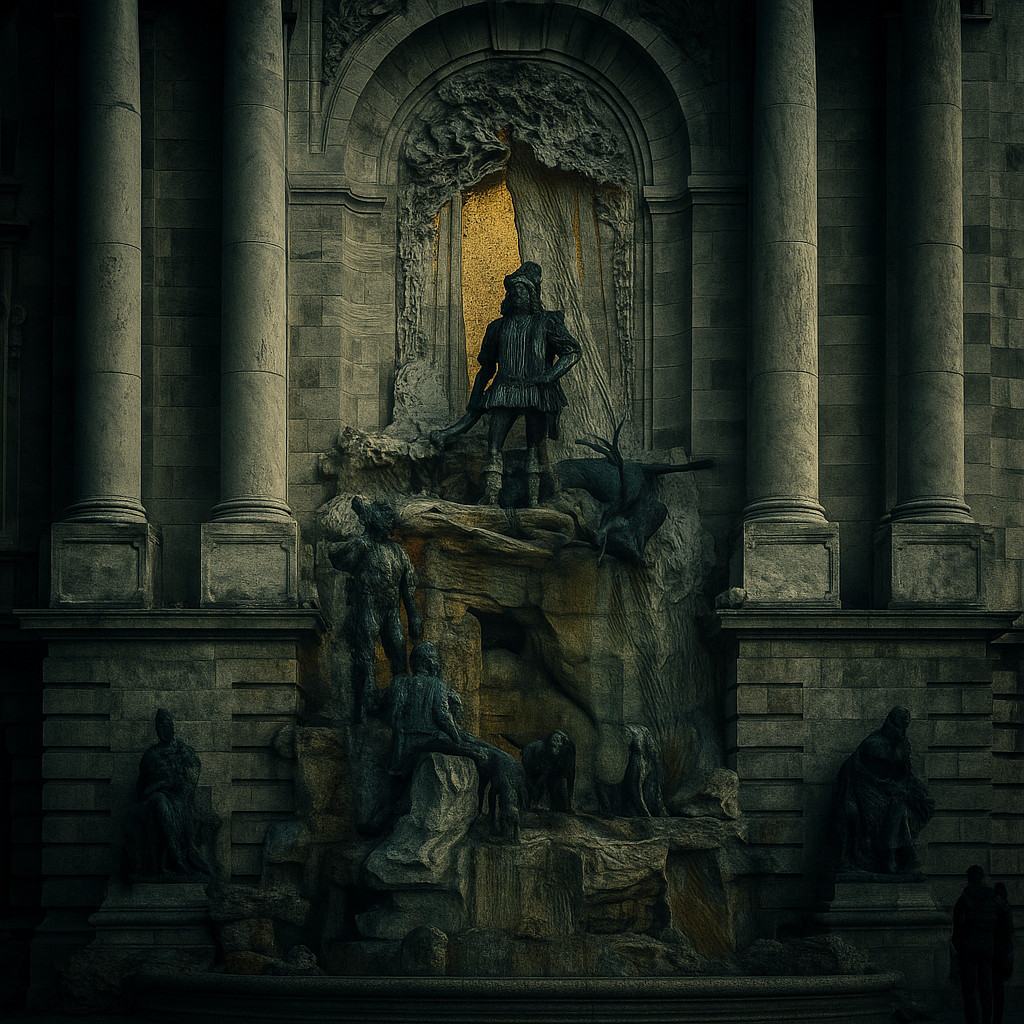
Among the courtyards of Buda Castle stands one of the most breathtaking sculptures in Budapest — the Matthias Fountain.
Known as the “Trevi Fountain of Hungary”, this Baroque masterpiece tells a story of royalty, legend, and a love that once captured the heart of a king.
For many visitors, the Matthias Fountain Buda Castle isn’t just a monument — it’s a living scene frozen in bronze, where art and myth meet under the open sky.
1. The King Behind the Fountain — Matthias Corvinus
At the heart of the Matthias Fountain Buda Castle is King Matthias Corvinus, one of Hungary’s most admired rulers.
Reigning from 1458 to 1490, he was a Renaissance king — warrior, scholar, and patron of the arts. His symbol, the raven, still adorns buildings and emblems across the city.
The fountain depicts him not in regal attire, but as a hunter. Dressed in armor, bow in hand, Matthias stands proudly above his court, frozen at the climax of a royal hunt. The scene blends realism and romanticism — an idealized vision of Hungary’s “Golden Age.”
If you explore the Buda Castle District further, you’ll find traces of Matthias’ legacy everywhere — from the Matthias Church that bears his name to his Renaissance court that once brought Italian artists to Budapest.
2. The Legend of Ilonka — A Love Story in Bronze
Behind the beauty of the Matthias Fountain Buda Castle lies a legend that gives it soul.
According to folklore, King Matthias fell in love with a peasant girl named Ilonka during a hunting trip. Unaware of his royal identity, she gave her heart to the mysterious hunter. When she later discovered he was the king, her heart broke from grief — a tale of love divided by class and fate.
In the sculpture, Ilonka kneels beside the slain deer, her gaze lowered in eternal sorrow. Her delicate posture contrasts with the king’s commanding stance, capturing a tragic balance between tenderness and power.
This story has become one of the most romantic and melancholic myths in Hungarian lore, echoed in the melancholic tone of other royal legends you’ll encounter at Vajdahunyad Castle and Fisherman’s Bastion.
3. The Artistic Vision — From Sketch to Stone
The Matthias Fountain Buda Castle was designed by sculptor Alajos Stróbl in 1904, during the Austro-Hungarian Empire’s final flourish of grandeur.
Stróbl, a master of realism and drama, envisioned the fountain as both a national symbol and an emotional tableau.
Bronze figures come alive on a rocky cliff of limestone. At the top, King Matthias towers above his hunters. Below, Ilonka weeps beside her loyal dog, while musicians, courtiers, and hounds gather around. Water cascades down the rocks, symbolizing the passage of time — from glory to memory.
The combination of metal, stone, and water gives the fountain a dynamic energy. At sunset, when golden light strikes the bronze, the figures seem to breathe again.
4. Symbolism and Interpretation
Beyond its visual beauty, the Matthias Fountain Buda Castle tells a deeper story about Hungary’s identity.
Matthias, the “Raven King,” symbolizes wisdom and justice; his pose reflects Hungary’s independent spirit and pride.
The deer — a recurring symbol in Hungarian mythology — represents purity and destiny, connecting this scene to ancient legends of the Miraculous Deer that led the Magyars to the Carpathian Basin.
The presence of Ilonka at his feet humanizes the monarch — reminding us that even kings are bound by emotion.
You can see this same blend of legend and symbolism throughout Buda Castle District, particularly in works like the Philosophers’ Garden or the Liberty Statue overlooking the Danube.
5. Wartime Damage and Restoration
Like much of Buda Castle, the fountain endured destruction during World War II.
Bombings left the statues scarred, the basin shattered, and the bronze figures darkened by fire.
After decades of neglect, restoration efforts in the 1970s and 2010s meticulously revived its splendor. Specialists repaired cracks, replaced missing parts, and cleaned the corroded surfaces — bringing back the noble shine of King Matthias and his retinue.
Today, the Matthias Fountain Buda Castle once again stands as one of the most photographed landmarks in Budapest, a testament to the city’s ability to rise — both literally and symbolically — from ruin.
6. Photography and the Perfect Moment
Every photographer in Budapest eventually finds their way to the Matthias Fountain Buda Castle.
Its dramatic composition — cascading water, shadowed niches, and metallic reflections — makes it irresistible at any hour.
For the best light, visit near sunset, when the bronze glows in deep amber tones. From this vantage point, you can capture not only the fountain but also the background of Danube River and Chain Bridge shining below.
Night photography is equally magical; the soft illumination brings out the details of the faces, turning the scene into a tableau vivant of Hungarian legend.
7. The Fountain’s Setting — The Courtyard of the Kings
Located in the western courtyard of Buda Castle, the Matthias Fountain commands attention as soon as you enter.
It stands opposite the Hungarian National Gallery, where works by Hungarian masters echo the same themes of national pride and melancholy beauty.
Nearby, the Hospital in the Rock Museum and the Buda Castle Labyrinth offer darker, underground counterparts to the fountain’s light-filled elegance.
Together, they represent the dual nature of Budapest — a city of light and shadow, myth and memory.
8. The Sound of Time — Water as Symbol
The trickle of water in the Matthias Fountain Buda Castle isn’t merely decorative.
It acts as a soundtrack — a reminder of time’s flow and the fragility of all empires.
In winter, when the water freezes, the statues take on an even more haunting quality, like figures suspended in a crystal tomb.
Come spring, as the ice melts, the fountain seems to awaken again — a metaphor for Budapest itself, reborn season after season.
9. A Stop on Your Castle Walk
The fountain makes a perfect pause during your exploration of the castle district.
You can reach it easily by taking the Castle Hill Funicular from the Chain Bridge or walking up the cobblestone streets past Matthias Church and Fisherman’s Bastion.
From here, continue toward the Philosophers’ Garden for sweeping views, or end your day at Leo Rooftop Bar with a drink overlooking the Danube.
Each step connects art, history, and beauty — exactly what defines Budapest at its best.
10. Legacy of the Matthias Fountain Buda Castle
More than a sculpture, the Matthias Fountain Buda Castle is a symbol of Hungary’s cultural pride.
It captures the soul of a nation that values romance as much as strength, intellect as much as power.
Visitors often linger here longer than planned — drawn by the stillness, the sound of falling water, and the aura of an eternal story told in bronze.
Before leaving, take one last look: the king stands proud, Ilonka kneels forever, and the deer lies motionless.
It’s a moment suspended in time — and in that silence, you’ll feel the timeless heartbeat of Budapest itself.
For more royal stories and hidden treasures, join our Budapest Walking Tour and uncover the legends that still echo through Buda Castle.
Matthias Fountain — Location on the Map
Hidden within the courtyards of Buda Castle, the Matthias Fountain mesmerizes visitors with its lifelike figures and cascading water. This iconic bronze monument portrays the legendary King Matthias on a royal hunt, embodying the spirit, power, and artistry of Hungary’s golden age.