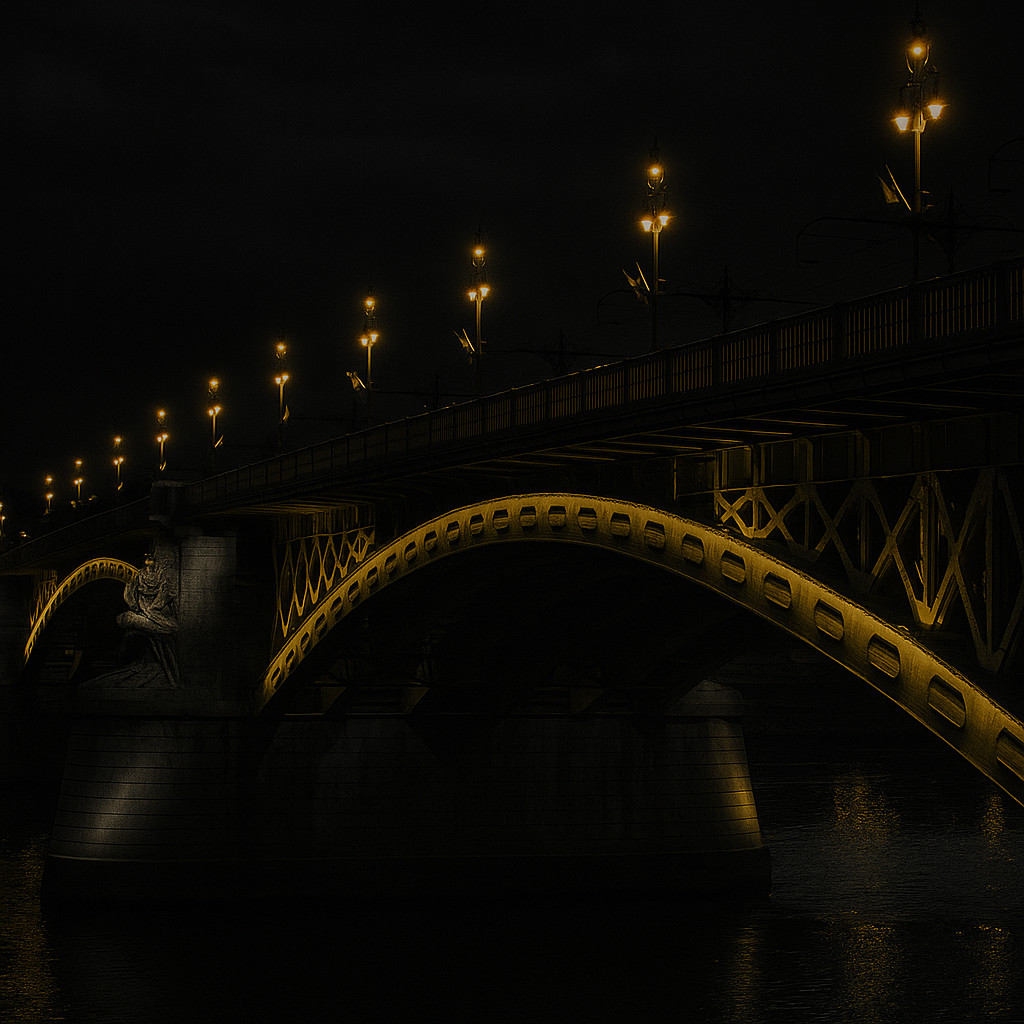
Among the many bridges that link the two halves of Hungary’s capital, Margaret Bridge Budapest (Margit híd) stands apart. It is not the longest, nor the most photographed — but it is the one that feels most alive.
Its golden steel ribs stretch across the Danube River like a graceful arc, connecting the elegance of Pest’s boulevards with the serenity of Margaret Island and the timeless hills of Buda.
To walk it at sunset is to see Budapest illuminated from within — a city reflected in its own heart.
A Bridge with Two Faces
The story of Margaret Bridge Budapest begins in the late 19th century, when the Austro-Hungarian Empire sought to unite its fast-growing twin cities, Buda and Pest. After the success of the Chain Bridge, the city commissioned a second grand crossing.
The design was entrusted to French engineer Ernest Goüin, and construction began in 1872 — a collaboration between Parisian innovation and Hungarian ambition. When it opened in 1876, it immediately became a symbol of progress and refinement.
Unlike other bridges, Margaret Bridge forms a 130-degree angle at its midpoint — a unique architectural feature that allows access to Margaret Island, a green paradise in the middle of the Danube. This elegant bend gives the bridge its distinctive grace and rhythm.
Engineering Beauty
Built of iron and gold-painted steel, Margaret Bridge embodies the optimism of the Belle Époque. Its intricate arches and sculpted pillars bear the coats of arms of Hungarian cities, while stone lions guard its entrances — a tribute to its older sibling, the Chain Bridge.
During World War II, however, tragedy struck. In 1944, the bridge was partially destroyed in an explosion that claimed hundreds of lives. After the war, it was painstakingly rebuilt according to its original plans, its golden hue restored as a beacon of resilience.
Today, it stands once more as an emblem of unity and endurance — proof that Budapest always rebuilds itself, more beautiful than before.
Walking Across History
To cross Margaret Bridge Budapest is to experience the rhythm of the city.
On one side, the grand avenues of Pest stretch toward Parliament and Liberty Square; on the other, the hills of Buda rise gently toward Fisherman’s Bastion and Gellért Hill.
Halfway across, a small lane leads down to Margaret Island — one of Budapest’s most peaceful escapes. Locals jog here in the morning, couples stroll at dusk, and the city’s skyline glows behind them like a living painting.
As night falls, the bridge’s golden lamps ignite, and the steel beams shimmer in reflection. It’s one of the most breathtaking scenes in all of Budapest, rivaled only by the view from the Liberty Bridge or the Elizabeth Bridge.
The Best Views
For photographers, Margaret Bridge offers perspectives unlike any other.
From its midpoint, you can see:
- Southward: the Parliament Building framed perfectly by the river.
- Northward: the Árpád Bridge and the gentle flow toward Óbuda.
- Beneath you: the calm waters surrounding Margaret Island, where willows bend toward the reflection of the sky.
At night, when the bridge lights burn amber and gold, the city feels like it’s breathing — a dialogue between water and light, between history and eternity.
Connecting the Soul of the City
While the Chain Bridge represents Budapest’s elegance and the Liberty Bridge its youthful energy, Margaret Bridge stands for balance — between motion and stillness, past and present.
It is used daily by thousands of commuters, cyclists, and dreamers.
Every hour, trams rattle softly across it, their yellow carriages glowing against the river’s silver surface. Below, tour boats glide beneath its arches, their reflections trembling in the current.
For locals, it’s more than infrastructure — it’s memory made metal.
A Bridge for All Seasons
In spring, the breeze carries the scent of blooming linden trees from Margaret Island. In summer, the heat ripples across its steel beams as pedestrians pause to watch boats drift below.
Autumn brings a soft melancholy — leaves swirl in the river’s current, and the bridge seems to whisper stories of love and loss.
And in winter, the lights of Pest shimmer through the fog like constellations reborn.
Whatever the season, Margaret Bridge Budapest reminds you that beauty is not static — it changes with light, weather, and emotion.
Nearby Attractions
Once you cross, the city unfolds in every direction:
- To the north: the peaceful Fő tér Óbuda, Budapest’s oldest square.
- To the south: the majestic Danube Promenade.
- To the east: City Park (Városliget) and the cultural heart of Pest.
- To the west: the narrow, story-filled streets leading to Buda Castle.
It’s not just a crossing — it’s a compass for discovering Budapest’s soul.
How to Visit
The easiest way to reach Margaret Bridge Budapest is by tram 4 or 6, which cross the bridge 24 hours a day — a rare continuity in a city that sleeps early.
If you prefer walking, start from the Parliament and follow the river north. The journey takes only ten minutes and rewards you with one of the city’s most unforgettable views.
Sunset and early evening are the best times to visit, when the bridge’s golden lights ignite and the Danube mirrors the last colors of day.
A Golden Thread Through Time
Margaret Bridge Budapest is more than steel and rivets — it’s the thread that ties together centuries of ambition, beauty, and endurance.
To stand on it is to feel Budapest breathing: proud, eternal, illuminated.
As you watch the lights ripple across the water, you’ll understand why this bridge, like the city itself, never truly grows old. It simply glows — softly, eternally, in gold.
Margaret Bridge Budapest — Location on the Map
Stretching gracefully across the Danube, Margaret Bridge connects the city’s two halves and the peaceful oasis of Margaret Island. With its distinctive curve and golden lights, it offers one of the most photogenic walks in Budapest, especially as the sun dips behind Buda’s hills.