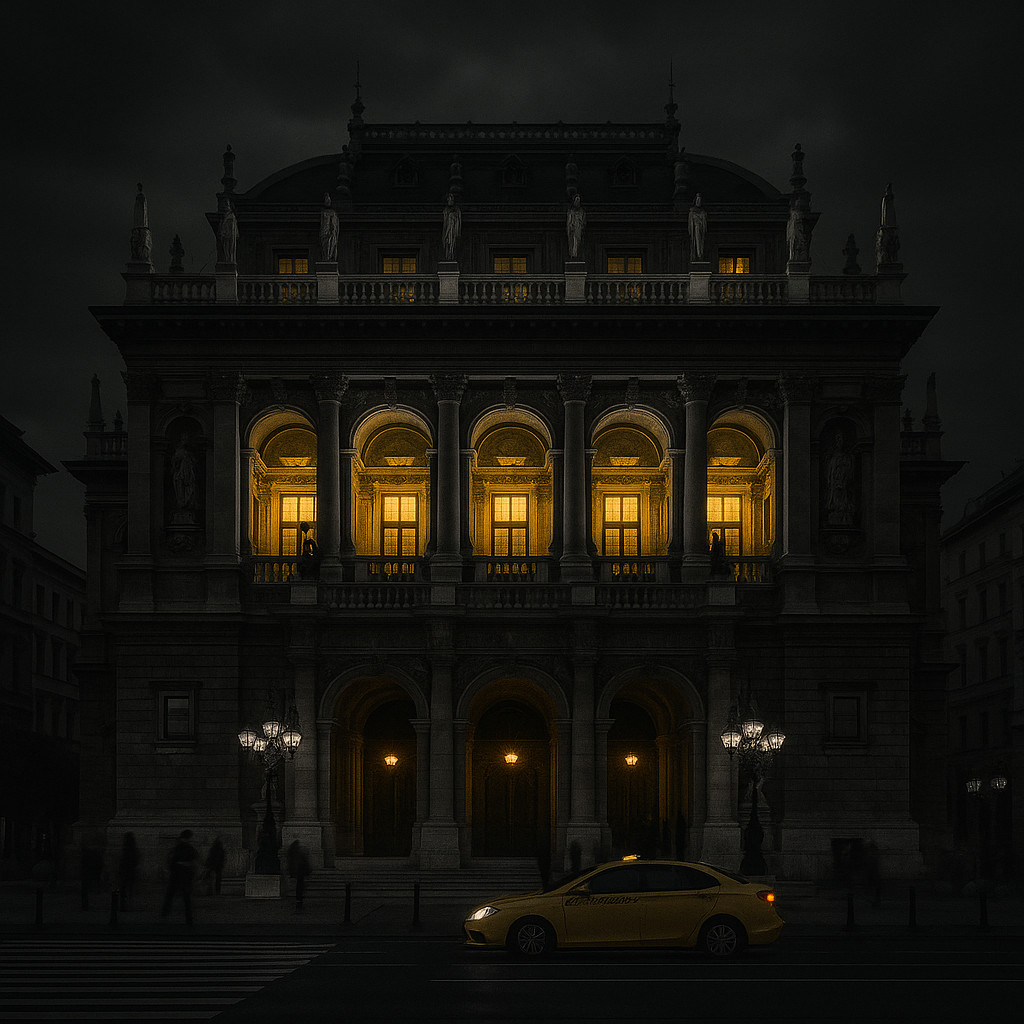
Few buildings in Europe capture the spirit of a nation as profoundly as the Hungarian State Opera House Budapest.
Rising along the elegant Andrássy Avenue, this neo-Renaissance masterpiece stands as both a temple of art and a monument to national pride. Its golden halls have echoed with the voices of Caruso, Callas, and countless Hungarian legends — yet even in silence, its architecture sings.
The Jewel of Andrássy Avenue
The Hungarian State Opera House Budapest was designed by Miklós Ybl, one of Hungary’s most revered architects, and inaugurated in 1884. Built during the height of the Austro-Hungarian Empire, it symbolized a cultural awakening — a statement that Hungary was not only politically strong, but artistically radiant.
The façade is adorned with statues of composers and muses; its grand staircase sweeps upward beneath frescoes that celebrate music as divine art. Inside, red velvet, marble, and gold leaf frame a space that glows like the interior of a jewel box.
From the street, the building itself seems to breathe elegance. The boulevard that connects it to Heroes’ Square feels like an overture — a slow crescendo that ends in architectural perfection.
Inside the Palace of Sound
Stepping into the Opera House is like entering another era. The scent of wood, the gleam of chandeliers, and the gentle hush of anticipation make every performance an experience beyond sound.
The auditorium, shaped in a perfect horseshoe, is acclaimed for its acoustic precision — rivaling even the great opera houses of Vienna and Milan. The ceiling’s fresco, painted by Károly Lotz, depicts the gods of Olympus listening to music — a vision of harmony between heaven and earth.
Each detail, from the sculpted balconies to the velvet-draped boxes, reminds visitors that the Hungarian State Opera House Budapest was conceived not just for entertainment, but as a cathedral for art.
The Voices That Shaped It
Over nearly a century and a half, this stage has hosted some of the most celebrated voices in history. It was here that Hungarian tenor József Simándy became immortal, and where global legends such as Luciano Pavarotti and Placido Domingo paid tribute to the city’s passion for opera.
Yet beyond fame and glamour, the Opera remains a living symbol of resilience. Through wars, revolutions, and renovations, it has endured — echoing the strength of a city that always rises in harmony.
The Surroundings — Where Elegance Never Ends
Located halfway along Andrássy Avenue, the Opera House stands at the gateway to some of Budapest’s most remarkable sites.
Just steps away, you’ll find St. Stephen’s Basilica, the House of Terror Museum, and the cafés that line the boulevard.
For a perfect cultural itinerary, walk down the avenue from the Opera House to Heroes’ Square, passing the tree-lined façades that once housed aristocrats and artists. In winter, the lights shimmer across the marble pavements; in summer, the scent of linden trees fills the air.
Rediscovery Through Renovation
After years of careful restoration, the Hungarian State Opera House Budapest reopened its doors in 2022 — more magnificent than ever. The renovation preserved its original splendor while enhancing comfort and modernizing backstage technology.
The orchestra pit was rebuilt, the gilded frescoes cleaned, and the chandeliers restored to their original brilliance. Even the velvet seats were reupholstered in tones that match Ybl’s 19th-century palette.
Now, attending a performance here is not only a cultural event but a journey into living history.
Visiting the Opera — A Must for Every Traveler
Even if you don’t attend a performance, visiting the Opera House is a highlight of any trip to Budapest. Guided tours run daily, offering insight into its history, architecture, and hidden corners — including the royal box once reserved for Emperor Franz Joseph.
The tours often end with a short live performance in the main hall, where a soprano’s voice rises beneath the golden dome — a sound that lingers long after it fades.
If you wish to plan your visit, the official website of the Hungarian State Opera provides schedules for upcoming performances, from Verdi and Puccini to Hungarian composers like Erkel and Kodály.
A Night to Remember
To truly experience the magic, attend an evening performance. The moment the orchestra begins, time dissolves. The chandeliers dim, the velvet curtains rise, and music becomes architecture.
From the balcony, you can look down upon an audience frozen in reverence — a sea of faces illuminated by gold and melody.
When the final note fades, step outside into the cool air of Andrássy Avenue. The streetlights glow softly, carriages echo in the distance, and the façade of the Opera gleams like a monument to art itself.
It’s an experience that transcends sound — a memory that defines what it means to fall in love with Budapest.
The Eternal Curtain Call
In a city of bridges, baths, and boulevards, the Hungarian State Opera House stands apart. It is where Hungary sings to the world — not in words, but in spirit.
Each performance is a reminder that beauty, once created, never truly fades.
It lingers in marble, in melody, and in the hearts of those who listen.
Hungarian State Opera House Budapest — Location on the Map
Standing proudly on Andrássy Avenue, the Hungarian State Opera House is one of Budapest’s most magnificent landmarks. Its richly decorated halls, grand staircase, and world-class performances continue to enchant audiences, celebrating more than a century of music, art, and national pride.