On the elegant Andrássy Avenue, among art palaces and cafés, stands one of Budapest’s most chilling landmarks. Behind its neoclassical façade, the House of Terror Budapest preserves the memory of Hungary’s darkest years — when two totalitarian regimes shaped the lives of millions.
This museum does not tell its story softly. It confronts visitors with fear, propaganda, and the machinery of control that once ruled the country. What today is a peaceful avenue was once the heart of surveillance and punishment. The building’s silence is heavy, but it speaks — of oppression, of courage, and of the cost of freedom.
A Building with a Terrifying Past
The house at Andrássy Avenue 60 is no ordinary address. It was first used by the Hungarian Arrow Cross Party during the Nazi occupation in 1944, and later by the Communist secret police after World War II. Within these walls, interrogations, tortures, and executions were part of daily life.
The museum’s designers preserved the building’s oppressive atmosphere. Cold corridors, cellars, and steel doors remain exactly as they were. Every step echoes history. Visitors descend into the basement, where the walls still remember the fear of those who never came back.
Yet this is not a place of horror alone — it is also a monument to survival.
The Museum of Communism
The House of Terror Budapest is often called Hungary’s Museum of Communism, and rightly so. It chronicles how ideology turned into oppression, and how ordinary citizens became both victims and tools of the system.
The exhibitions are not static displays. They are experiences. Film clips, personal letters, and propaganda songs create a sense of immersion. You walk through rooms that re-create offices of the secret police, interrogation chambers, and propaganda halls.
Each space explores a theme — betrayal, fear, silence, control. The architecture itself is part of the message: narrow corridors, dim light, and the echo of marching boots remind you that this was once the machinery of power.
Design and Emotion
From the moment you enter, the museum overwhelms the senses. The lighting is low, the air is cold, and the soundtrack of whispered voices sets the tone. One of the most striking features is the central elevator — it moves slowly, with a video describing the final moments of those executed in the basement.
It is impossible to remain indifferent. The House of Terror Budapest transforms pain into awareness. By the time you leave, you understand how ideology and fear can destroy human dignity.
The curators designed the experience to be personal. You are not just a spectator — you walk in the footsteps of victims and witnesses.
From Fascism to Communism
Few buildings in Europe have seen such a transition of terror. The House of Terror Budapest reminds visitors that Hungary’s 20th century was marked by two dictatorships: Nazi and Soviet.
The museum’s upper floors focus on the fascist period — uniforms, photos, and personal belongings of those who collaborated or resisted. Lower levels descend into the Communist era, where secret documents and surveillance tools show how the regime controlled thought and speech.
Both systems shared one thing: the desire to dominate the human spirit. This museum ensures their memory will never fade.
A Memorial to the Victims
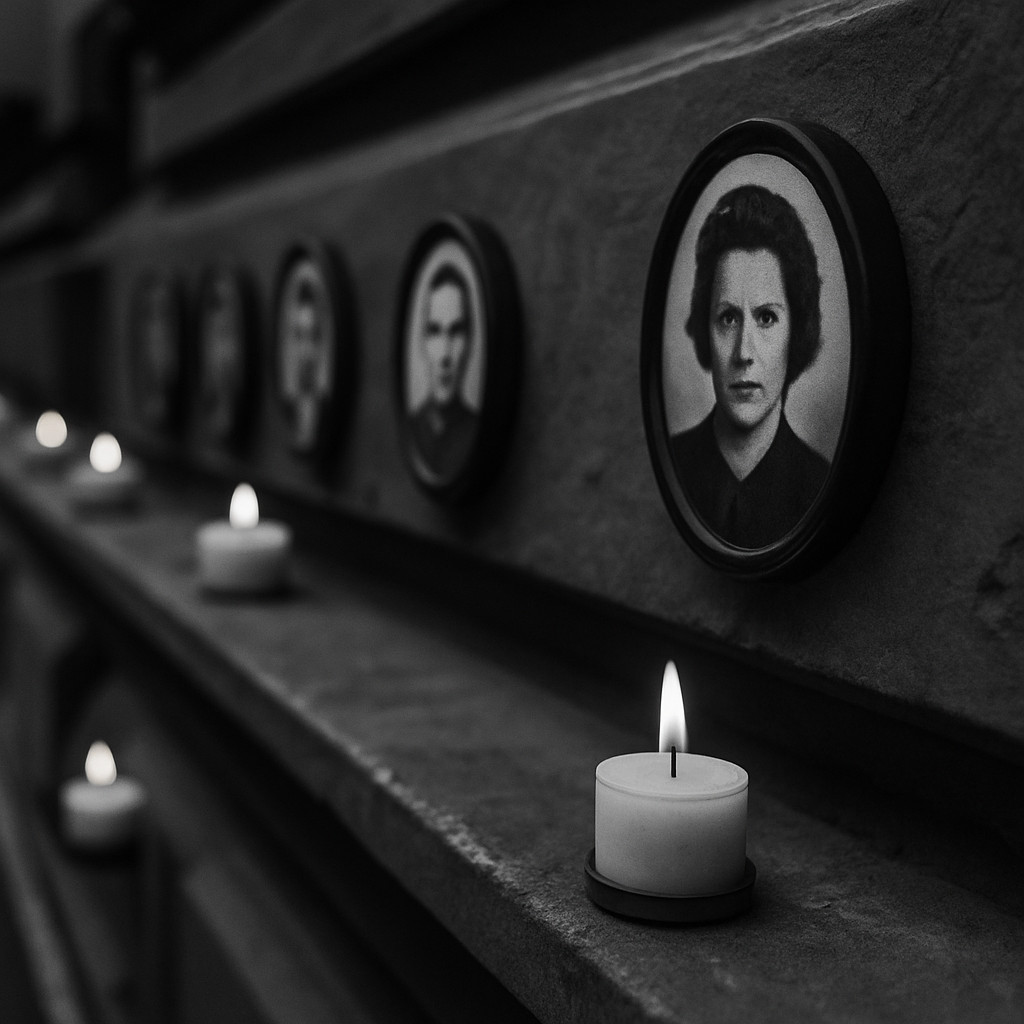
Outside the building, a long wall covered in black metal displays hundreds of portraits — victims of both regimes. It is one of Budapest’s most powerful memorials. People often stop there in silence, reading names, faces, and stories.
Inside, candles burn beside personal items — watches, pens, photographs — left by families who lost someone. The museum turns suffering into remembrance, ensuring the atrocities committed here are never repeated.
Visiting the Museum
The House of Terror Budapest is located at 60 Andrássy Avenue, near Oktogon, in the heart of Pest. The nearest metro stop is Oktogon on Line M1, the oldest underground line in continental Europe.
The museum is open every day except Monday, with guided tours available in several languages. Photography is limited inside due to the sensitive nature of the exhibits, but visitors are encouraged to take their time — the experience is emotional and intense.
For current information on tickets, hours, and exhibitions, visit the sitio oficial: terrorhaza.hu.
Nearby Landmarks
After visiting, it helps to reconnect with light. A short walk along Andrássy Avenue will take you to the Hungarian State Opera House Budapest, a masterpiece of music and architecture.
Continue toward Heroes’ Square Budapest and the Museum of Fine Arts, where art replaces ideology with inspiration. Or visit the Hungarian National Museum, which tells the story of Hungary’s struggle for independence.
Together, these sites form a journey — from oppression to beauty, from darkness to light.
Why It Matters
The House of Terror Budapest is not a museum of horror; it is a museum of truth. It forces us to look directly at what happens when fear governs a nation. Every country carries scars, but few have turned them into a lesson as powerfully as Hungary.
Its message is timeless: liberty is fragile, and remembering is the only way to protect it.
As you leave Andrássy Avenue 60, the façade’s iron letters still cast their shadow across the pavement — the word TERROR reflected upside down. It is a haunting reminder that history can reverse itself when forgotten.
Here, remembrance becomes resistance.
House of Terror Museum Budapest — Location on the Map
Located on Andrássy Avenue, the House of Terror Museum exposes the brutal history of 20th-century dictatorships in Hungary. Once the headquarters of both the fascist Arrow Cross and the communist secret police, today it stands as a powerful memorial to the victims of tyranny.