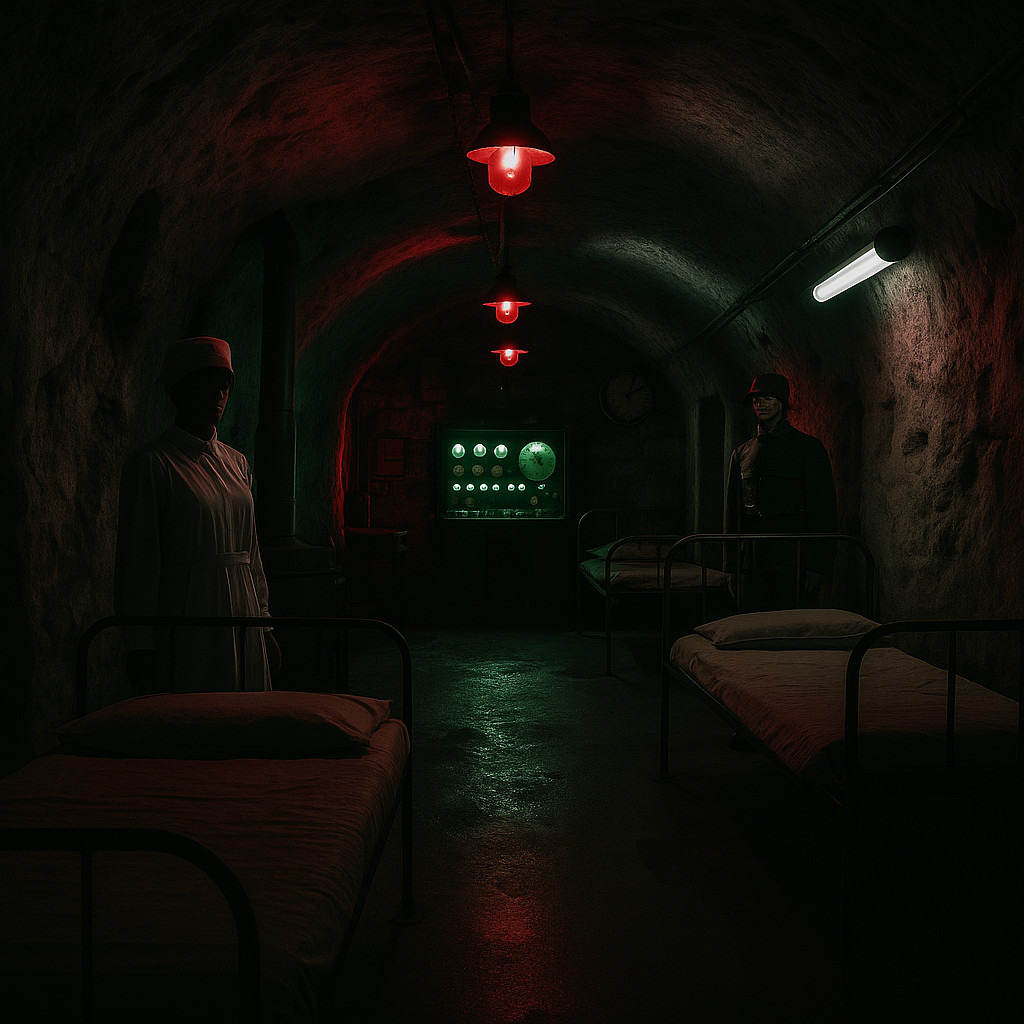
Beneath the quiet cobblestone streets of Buda Castle, hidden in the heart of the hill, lies one of the most haunting and fascinating sites in Budapest — the Hospital in the Rock Budapest.
A place where history was not written with ink, but with whispers, fear, and courage.
Here, time stands still. The air feels heavy with the echo of footsteps from doctors, nurses, and soldiers who once fought to preserve life while the city above collapsed in flames.
A Wartime Sanctuary Beneath Buda Castle
The Hospital in the Rock Budapest was built in the natural caves beneath the Buda Castle District.
During World War II, as bombs tore through the city, these tunnels were transformed into a secret medical refuge.
Between 1939 and 1945, doctors treated the wounded by candlelight, with little medicine and no fresh air.
What was once a medieval cave system became a hospital carved into the earth — a sanctuary born from necessity.
From Secret Hospital to Cold War Bunker
After the war, Budapest entered another kind of darkness.
The hospital was expanded and fortified as part of Hungary’s Cold War defense strategy.
It became an atomic shelter — the Nuclear Bunker Museum — ready to protect the country’s leaders and treat radiation victims in case of nuclear disaster.
Walking through its narrow corridors, you see the thick concrete walls, the old generators, and the eerie gas masks still hanging on the hooks.
It feels like a time capsule, a frozen reminder of how close the world once came to the edge.
Life and Fear Underground
The Hospital in the Rock Budapest was designed to save lives under impossible conditions.
Doctors and nurses worked for days without sleep.
The wounded soldiers filled every corridor, and the smell of antiseptic mixed with gunpowder and smoke.
Visitors today can still see the original stretchers, surgical lamps, and even the wax figures that recreate the chaos of those days.
The soundscape — faint sirens, distant bombing — adds to the chilling realism.
It is both museum and memorial.
The Cold War Legacy
After 1956, during the Hungarian Revolution, the underground complex was used again to treat civilians and soldiers.
Later, in the 1960s, it was converted into a nuclear bunker, complete with decontamination chambers, oxygen generators, and food storage.
While other European capitals built monuments of progress, Budapest built one of fear — a testament to the fragility of peace.
The Hospital in the Rock Budapest is one of the few places in Europe where you can still feel that Cold War paranoia sealed into stone.
A Journey Through the Past
The museum today is both terrifying and moving.
Guided tours lead visitors through long tunnels where the air temperature remains a constant 15°C (59°F).
The dim lights flicker on old instruments, and mannequins in doctor’s coats seem to watch silently as you pass.
It’s the same chilling beauty found in other underground worlds like the Buda Castle Labyrinth, but here, reality replaces myth.
The Hospital in the Rock Budapest is not legend — it’s truth preserved.
Heroes of the Underground
The museum honors the real people who risked everything to help others.
Hungarian nurses, Red Cross volunteers, and anonymous civilians worked side by side during air raids, even as supplies ran out.
Their courage is immortalized in letters, photos, and preserved medical records displayed inside the museum.
The atmosphere feels sacred.
Like the Shoes on the Danube Bank memorial, it speaks not only of tragedy, but of humanity’s ability to endure.
Architecture of Survival
What makes the Hospital in the Rock Budapest remarkable is its design — a mixture of natural cave walls and wartime engineering.
Steel doors seal off entire sections, and massive filters still stand ready to clean the air.
The contrast between the rough rock and the sterile hospital beds is surreal.
Even the silence feels engineered, as if the mountain itself remembers every heartbeat that once echoed through its veins.
How to Visit
- Location: Lovas út 4/c, beneath Buda Castle Hill.
- Access: Take the Castle Hill Funicular or bus 16 from the Chain Bridge.
- Tours: Guided tours every hour in English and Hungarian.
- Tickets and information: Visit the official website.
- Temperature: Always cool — bring a jacket.
- Tickets: Around 6,000 HUF for adults.
After your visit, continue exploring the nearby Matthias Church and Fisherman’s Bastion for breathtaking contrast — sunlight and silence above, shadows and memory below.
Why You Should Go
The Hospital in the Rock Budapest is not a typical museum.
It is a descent into conscience — a reminder that history is not just what we celebrate, but also what we survive.
Standing here, surrounded by the ghosts of those who once fought for life beneath the city, you realize that the most powerful monuments are often the ones carved into the dark.
Hospital in the Rock Budapest — Location on the Map
Beneath the Buda Castle lies the Hospital in the Rock, a haunting reminder of Hungary’s wartime past. This underground museum, carved directly into the stone, once served as an emergency hospital and atomic shelter — today it offers a powerful journey through the city’s hidden history.