Few places capture Hungary’s national pride like Heroes’ Square Budapest. Located at the grand end of Andrássy Avenue, this vast plaza marks the entrance to City Park (Városliget) — one of the most emblematic areas of the capital. Here, surrounded by museums, monuments, and fountains, Budapest’s history stands carved in stone and bronze.
The Heart of National Identity
Built to commemorate the 1000th anniversary of the Magyar conquest of the Carpathian Basin, Heroes’ Square Budapest embodies the story of a nation that endured, united, and thrived.
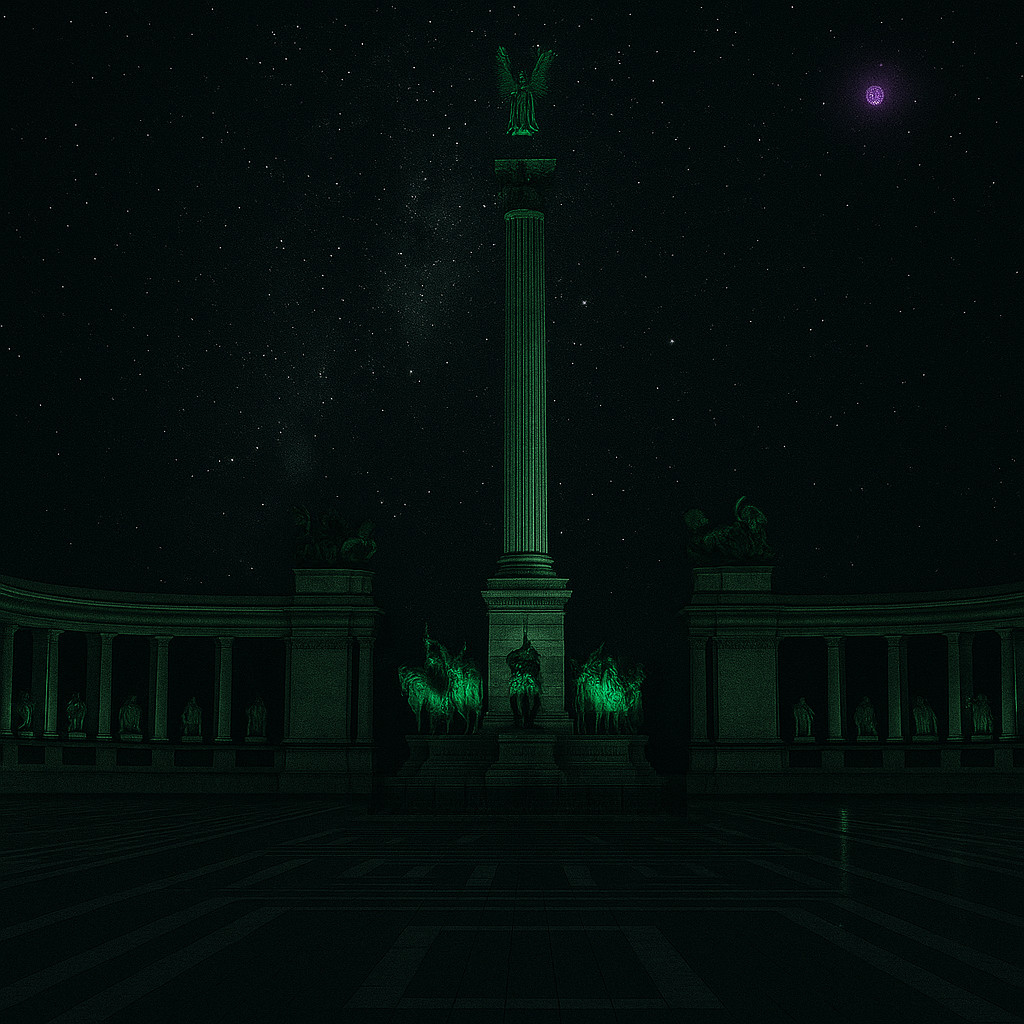
At its center rises the Millennium Monument, crowned by the Archangel Gabriel holding the Hungarian Holy Crown and the apostolic double cross — a vision of divine and national unity.
Beneath him, a semicircle of bronze warriors dominates the pedestal: the Seven Chieftains of the Magyars. They were the founders of the Hungarian tribes, who led their people across the plains into a new homeland around the year 895.
Their names — Árpád, Előd, Ond, Kond, Tas, Huba, and Töhötöm — are more than history; they are legend. Each statue captures motion and pride, with fierce faces and galloping horses that seem alive under the Hungarian sun.
Kings, Freedom Fighters, and Founders
Flanking the column, two grand colonnades form an arc around the square. On the left, Hungary’s early monarchs stand tall. You can recognize King Saint Stephen I, who established the Christian kingdom; Saint Ladislaus I, the knight-king; and Coloman the Learned, who brought education and law to medieval Hungary.
The right colonnade honors more recent heroes — those who defended Hungarian independence and freedom. Among them stands Lajos Kossuth, the revolutionary leader of 1848, his bronze figure radiating determination. Beside him, you’ll find figures representing courage across centuries: rulers, statesmen, and patriots whose stories shaped the country’s destiny.
Together, these statues create a gallery of national memory. They remind every visitor that Heroes’ Square Budapest is not just a monument, but a dialogue between generations — a stage where history continues to speak.
Architecture and Surroundings
The plaza itself is an architectural masterpiece. Wide and perfectly symmetrical, it’s framed by two cultural pillars: the Museum of Fine Arts Budapest on the left, and the Palace of Art (Műcsarnok) on the right. Their neoclassical façades mirror one another, creating a visual harmony that enhances the monument’s grandeur.
From the center of the square, Andrássy Avenue stretches like an arrow back toward the city center, linking the space with the Hungarian State Opera House and eventually the St. Stephen’s Basilica Dome View. Behind the monument lies City Park, home to several landmarks — including the fairytale Vajdahunyad Castle, the relaxing Széchenyi Thermal Bath, and even the City Park Balloon that floats above the skyline.
A single visit to Heroes’ Square can easily turn into a full day of discovery.
A Walk Through Time
Begin your walk from the Memorial Stone of Heroes, located in front of the central column. It’s often called the Tomb of the Unknown Soldier, though it commemorates all who gave their lives for Hungary’s freedom.
From there, take time to explore each statue and relief. Every step reveals new symbolism: angels, soldiers, and mythic figures captured mid-motion. The bronze details glimmer under sunlight, but at dusk they gain a solemn, almost sacred presence — especially when the lamps ignite and the shadows of the colonnades stretch across the marble ground.
At night, the square becomes one of the Best Sunset Spots in Budapest. The golden hour paints the statues in amber hues, and the fountain nearby catches the glow of the sky. It’s the perfect moment to take photographs, sit on the steps, and let the past unfold quietly before you.
How to Visit
You can reach Heroes’ Square Budapest easily by taking the historic M1 metro line to Hősök tere station — the oldest underground line in continental Europe. But walking from the city center along Andrássy Avenue is far more rewarding, allowing you to experience the gradual reveal of the monument framed by trees and grandeur.
Once you arrive, the space feels both vast and intimate. It’s not just a tourist site but a place of reflection — one that resonates with locals who gather here for national holidays and moments of remembrance.
The Symbolism of Light
When night falls, the entire square transforms. Warm lights wash over the colonnades, highlighting every fold in the bronze cloaks and every feature of the horses. The Archangel Gabriel, high above, glows against the black sky like a guardian watching over the city.
From here, you can continue your evening at Széchenyi Thermal Bath or explore Danube River Cruise Budapest for a view of the bridges shimmering in the distance. Wherever you go next, the memory of Heroes’ Square lingers — vast, noble, unforgettable.
Why Heroes’ Square Budapest Matters
Heroes’ Square is more than architecture. It’s an emotion. It celebrates courage, unity, and the enduring will of a people who refused to fade. Every visitor feels its gravity — the silence between steps, the echo of history beneath the open sky.
It’s not just one of the most famous squares in Europe; it’s the soul of Budapest. When you stand here, surrounded by kings and warriors, you stand where Hungary remembers who it is.
Heroes’ Square Budapest — Location on the Map
At the entrance to City Park, Heroes’ Square is Budapest’s most iconic gathering place, framed by museums and monumental statues. Its soaring column and sculptures celebrate a thousand years of Hungarian history, offering one of the city’s most inspiring and photogenic landmarks.