The White Bridge That Connects Buda and Pest
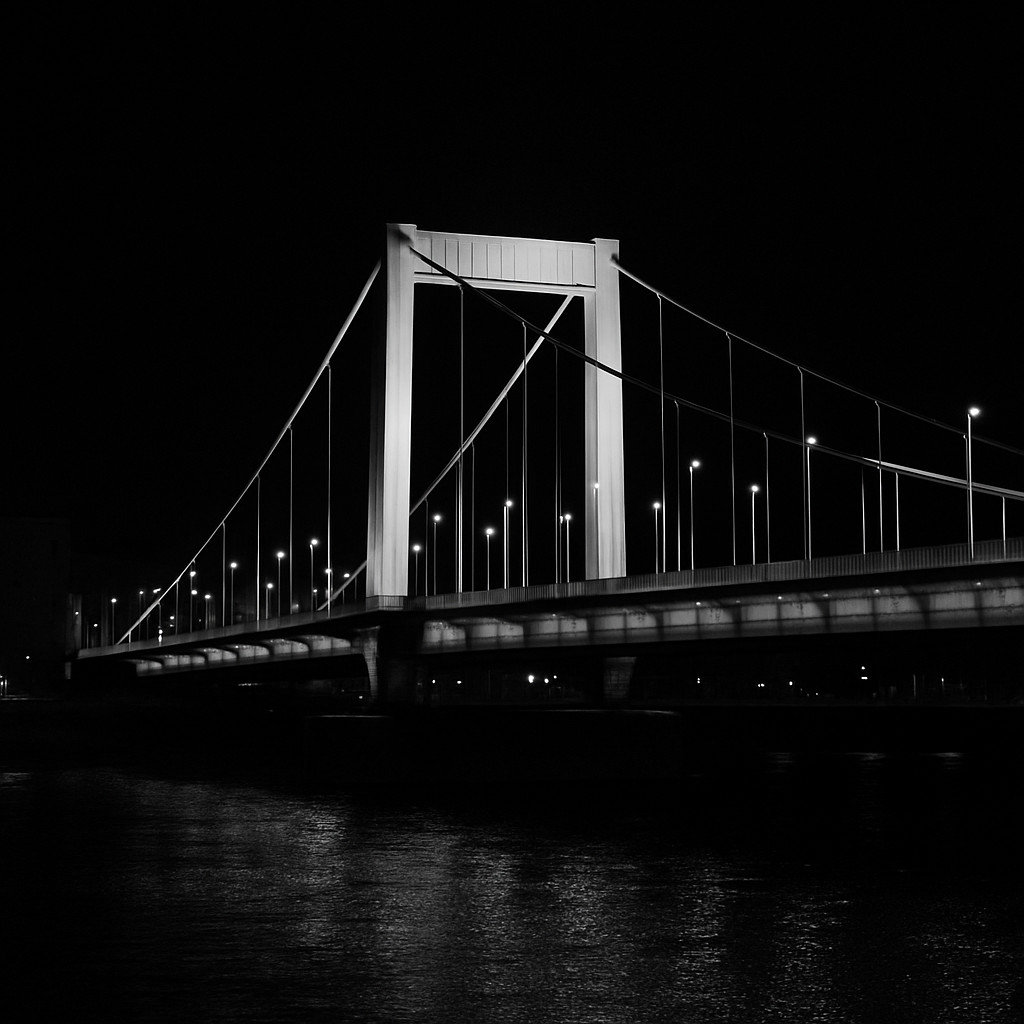
Elisabeth Bridge Budapest stretches across the Danube like a shining ribbon of light. Its white cables and elegant form link the steep slopes of Gellért Hill with the busy heart of Pest. Sleek and minimal, it is both a symbol of modernity and a memorial to resilience.
Named after Empress Elisabeth of Austria (Sisi), the bridge honors one of Hungary’s most beloved figures. She embodied compassion, beauty, and independence — the same qualities that define this luminous structure. When night falls, the bridge glows softly against the black water, a pure white gate uniting two worlds.
The First Elisabeth Bridge and Its Destruction
The story of Elisabeth Bridge Budapest begins in 1903, when the original bridge opened as one of the most beautiful suspension bridges in Europe. Its chain design made it the longest of its kind at the time. The bridge quickly became a proud emblem of Budapest’s elegance and engineering skill.
However, the joy was short-lived. During World War II, German troops destroyed every bridge along the Danube to halt the advancing Soviet forces. Elisabeth Bridge collapsed into the river along with the rest, leaving only its stone pillars behind. For nearly twenty years, those ruins stood as silent witnesses of a wounded city.
The Rebirth of Elisabeth Bridge Budapest
Budapest began to rebuild after the war, and in 1964 the bridge was reborn. The new Elisabeth Bridge Budapest kept the same location but adopted a modern, clean design by engineer Pál Sávoly. It was no longer a chain bridge but a graceful cable-supported structure of white steel.
The rebirth of the bridge reflected the rebirth of the city. It was no longer about ornate beauty but about clarity, strength, and optimism. Its white color was deliberately chosen to represent renewal and peace after decades of conflict. Today, it remains a symbol of that transformation.
Elisabeth Bridge and the Memory of Empress Sisi
The bridge takes its name from Empress Elisabeth of Austria, affectionately called Sisi, who ruled during the Austro-Hungarian Empire. She was known for her deep affection toward Hungary and for helping to secure its partial independence in 1867.
After her assassination in 1898, she became an icon of grace and melancholy. Naming the bridge after her was both tribute and remembrance. Near the Pest side of the bridge, a bronze statue of Elisabeth stands surrounded by flowers — a quiet corner where visitors can reflect on her lasting connection with Hungary.
Walking Across Elisabeth Bridge Budapest
Crossing Elisabeth Bridge Budapest is one of the most atmospheric walks in the city. The white structure rises gently above the river, offering spectacular views of Gellért Hill Budapest and Buda Castle.
On the Buda side, the road curves beneath the hillside and leads toward the Gellért Thermal Bath — a masterpiece of Art Nouveau architecture and a sanctuary of healing waters. The Statue of Saint Gellért looks down from the cliff, illuminated at night beside a cascading waterfall.
On the Pest side, the bridge ends at Március 15 Square, one of the oldest areas of the city. The Inner City Parish Church, standing nearby, is among Budapest’s earliest surviving churches. From here, narrow cobbled streets lead directly to Váci Street Budapest, filled with cafés and life.
Architecture and Atmosphere of Elisabeth Bridge Budapest
Unlike the ornate Chain Bridge Budapest or the colorful Liberty Bridge Budapest, this bridge embraces simplicity. Its straight lines and white frame let the cityscape shine around it.
The modern Elisabeth Bridge Budapest spans 290 meters, supported by two pylons rising high above the Danube. It is a perfect example of mid-20th-century functional architecture — minimalist yet striking. In daylight, it gleams against the blue sky; at dusk, it becomes ethereal, hovering over the golden river like a vision of light.
Night Views from Elisabeth Bridge Budapest
As night descends, Elisabeth Bridge Budapest becomes a favorite spot for photographers. Its reflection stretches across the water while the Liberty Statue on Gellért Hill glows softly in the distance. The contrast of white steel, black water, and yellow streetlights creates a cinematic scene.
Walking across it after sunset reveals one of the most romantic panoramas in Budapest. To the north, Chain Bridge Budapest glimmers with its classic lamps. To the south, Liberty Bridge Budapest stands in green, its arches glowing against the night. Between them, Elisabeth Bridge appears almost weightless — the bridge of light.
The Symbolism of the White Bridge
Every bridge in Budapest has a story. Elisabeth Bridge Budapest tells one of renewal and grace. It replaced destruction with simplicity, and mourning with beauty. Its white color represents peace, its name represents love, and its presence connects the past with the present.
Crossing it is more than moving between Buda and Pest; it is stepping through time — from the echoes of war to the confidence of a city reborn.
Nearby Places to Visit
If you visit Elisabeth Bridge Budapest, take time to explore its surroundings:
- Gellért Hill Budapest — for panoramic views and history.
- Gellért Thermal Bath Budapest — for architecture and relaxation.
- Váci Street Budapest — for shopping and cafés.
- Danube Promenade — for scenic riverside walks.
- Chain Bridge Budapest — for historic contrast.
Each site completes the story of this area, connecting the river’s crossings into a continuous journey through Budapest’s character.
The White Bridge of Budapest
Ultimately, Elisabeth Bridge Budapest is more than a crossing. It is an emblem of endurance, simplicity, and light. Its white structure reflects not only the city’s skyline but also its spirit — the ability to rebuild with beauty after hardship.
When you stand in the middle of the bridge and look both ways, you see the story of Budapest itself — ancient, elegant, and ever alive. The Danube flows beneath, carrying the reflections of time, and the bridge glows above it all — forever white, forever proud.
Elisabeth Bridge Budapest — Location on the Map
Elisabeth Bridge, known locally as Erzsébet híd, stands out with its bright white structure linking Buda and Pest. Built in the 1960s on the ruins of its historic predecessor, it embodies postwar renewal and offers breathtaking views of the Danube and Gellért Hill.