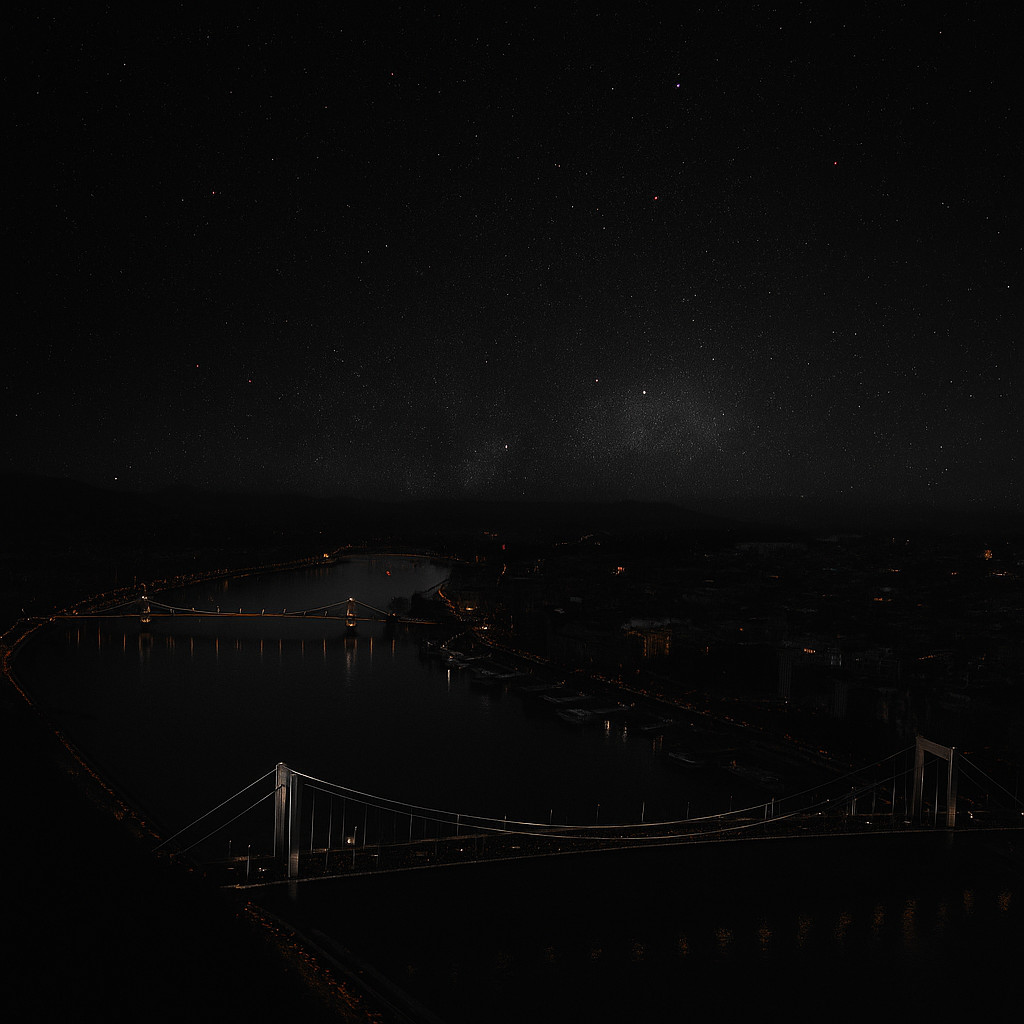
The Bridges of Budapest are more than engineering marvels. They are symbols of resilience, beauty, and the eternal unity of the Hungarian capital.
Each one tells a different story — of ambition, destruction, and rebirth — yet together they form one of the most breathtaking skylines in Europe.
Stretching across the Danube River, the Bridges of Budapest link Buda and Pest, two worlds that breathe as one. When night falls, their lights shimmer like golden veins reflected in the moving water.
The Chain Bridge Budapest — Where the City Was Born
The story of the Bridges of Budapest begins with the Chain Bridge Budapest, the first permanent crossing over the Danube.
Completed in 1849, it united Buda and Pest into a single capital — the heart of modern Hungary.
Count István Széchenyi’s dream came to life through British engineer William Tierney Clark.
The stone lions at each end became silent guardians of the city’s progress.
Even after destruction in World War II, the Chain Bridge rose again — a timeless reminder that unity is Budapest’s strongest bridge.
Chain Bridge Budapest — Location on the Map
The Chain Bridge stands as the historic heart of Budapest — the link that joined Buda and Pest into one city. Its iron chains and stone lions have witnessed revolutions, celebrations, and centuries of change, earning it a place among the world’s most admired bridges.
The Liberty Bridge Budapest — Green Light of Freedom
Among the Bridges of Budapest, the Liberty Bridge stands out as a symbol of independence.
Built for Hungary’s 1896 millennium celebration, it was later renamed to honor freedom itself.
Its emerald lights glow at night, reflecting gently on the Danube. Crowned by Turul birds, mythical protectors of Hungary, the bridge connects the elegant Great Market Hall with the thermal majesty of Gellért Hill.
During summer evenings, locals sit on its beams to watch the sunset — transforming this masterpiece into a living balcony of light and laughter.
Liberty Bridge Budapest — Location on the Map
Painted in its signature green, Liberty Bridge is a favorite among locals for its charm and panoramic views. Once opened by Emperor Franz Joseph himself, it has since become a symbol of unity and endurance — where the spirit of Budapest shines brightest after dusk.
The Margaret Bridge Budapest — Golden Grace Over Water
The Margaret Bridge Budapest is often called the most graceful of the Bridges of Budapest.
Its golden lights curve elegantly above the river, leading directly to Margaret Island — the city’s green heart.
Built in 1876, its unique 130° angle gives it both beauty and purpose.
Destroyed during World War II and reconstructed with precision, it now glows every night like a golden arc of endurance.
Moreover, the bridge serves as a peaceful viewing point to admire both Buda Castle and the Parliament Building at once.
Margaret Bridge Budapest — Location on the Map
Margaret Bridge, with its elegant curve and golden hue, stands as one of Budapest’s most romantic spots. Connecting both sides of the Danube and the lush Margaret Island, it invites visitors to enjoy panoramic strolls above the water where the city’s beauty unfolds in every direction.
The Elizabeth Bridge Budapest — A White Line of Modern Grace
Next among the Bridges of Budapest stands the Elizabeth Bridge Budapest, named after Queen Elisabeth, “Sisi.”
Originally built in 1903, it was once Europe’s most elegant suspension bridge.
After being destroyed during the war, it was reborn in 1964 with a sleek, minimalist design — a white thread connecting the past and the present.
Today, it gleams in pure light, offering panoramic views of Gellért Hill and the Citadella.
Its simple beauty contrasts perfectly with the ornate older bridges nearby.
Elizabeth Bridge Budapest — Location on the Map
Spanning the Danube with modern elegance, the Elizabeth Bridge connects Buda’s hills and Pest’s vibrant center in a single, fluid line. Its minimalist white design makes it one of the most striking bridges in Budapest, especially when illuminated at night above the flowing river.
War, Loss, and Rebirth
Every one of the Bridges of Budapest shares the same destiny: destruction and resurrection.
In 1945, every bridge over the Danube was destroyed. However, within a few years, Budapest restored each one — not as imitation, but as resurrection.
Therefore, to walk across any of these bridges is to walk over history itself.
They are not just physical crossings but emotional ones — bridges between pain and recovery, darkness and light.
The Bridges of Budapest as Living Art
Seen from above, the Bridges of Budapest create what locals call “the golden necklace” of the city.
Their reflections on the Danube form a moving constellation of gold, silver, and emerald light.
From Gellért Hill or a Danube River Cruise, the view is unforgettable — a dance of light uniting the heart of Europe.
Moreover, each bridge tells a unique story, forming a dialogue between eras and emotions.
Walking the Bridges of Budapest
Exploring the Bridges of Budapest on foot is one of the city’s most meaningful experiences.
Start your journey at the Chain Bridge at sunrise — when the city is still half-asleep and the air smells of stone and river.
Then cross to Pest, walk south along the promenade, and reach the Liberty Bridge at sunset — glowing green as trams pass silently overhead.
Finally, continue toward the Elizabeth Bridge, watching its white lines reflect on the darkening water.
Every step is a story, every crossing a connection.
Beyond the Bridges
The Bridges of Budapest reveal a city that never stops reinventing itself.
To the north lies Óbuda’s Fő tér — the city’s oldest square, a whisper of medieval times.
To the south, modern bridges like Rákóczi stretch toward tomorrow.
Meanwhile, between past and future, these bridges hold Budapest together — not just physically but spiritually.
The Eternal Connection of the Bridges of Budapest
The Bridges of Budapest are more than architecture — they are a language of light.
They tell of unity after division, of creation after destruction.
And when night falls, their reflections transform the Danube into a mirror of eternity.
Stand on one of them, feel the wind from the river, and you’ll understand why Budapest doesn’t simply exist — it endures.
The Bridges of Budapest remind us that beauty can emerge from resilience, and that connection is the most powerful form of strength.